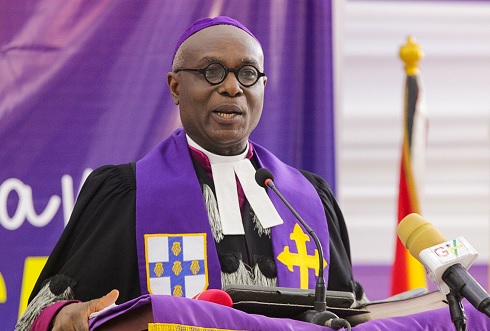
The Presiding Bishop of the Methodist Church Ghana, Professor Kwabena Asamoah-Gyadu, has issued a strong caution against what he describes as a growing culture of “deceptive prophetic phenomenon” in contemporary Christianity, following public fallout from failed prophecies linked to the just-ended New Patriotic Party (NPP) presidential primaries.
In a Facebook post published on Saturday, 31 January 2026, Prof Asamoah-Gyadu, who also serves as Baëta-Grau Professor of Pentecostalism at the Trinity Theological Seminary (TTS), Ghana, lamented what he called the tragic extent of prophetic failures within global and local Christian spaces.
His intervention comes in the wake of the NPP primaries that elected Dr Mahamudu Bawumia as flagbearer for the 2028 general elections, an outcome that contradicted several widely publicised prophecies and forced at least one prominent Ghanaian prophet to issue a public apology.
‘Catastrophic prophetic failures’
“The extent of catastrophic prophetic failures in Christianity today is tragic,” Prof Asamoah-Gyadu wrote, situating the Ghanaian experience within a broader global crisis of credibility facing prophetic ministries.
He cited recent developments in the United States, where Shawn Bolz, a well-known charismatic figure, was dismissed by his church after being exposed for allegedly mining personal information about church members from the internet and presenting it as prophetic revelation.
do not-fake-the-voice-of-god-methodist-presiding-bishop-warns-as-prophetic-failures-rock-christianity%2
“In the USA, Shawn Bolz, a so-called prophet, has recently been exposed and dismissed by his church for mining information on church members from the internet and using them as prophetic insights,” he noted, before adding pointedly: “It is happening in our country too!”
The Methodist leader issued a pastoral warning to ministers, particularly within his own denomination, against the lure of what he termed “prophetic vainglory”.
“I pray no minister of the Methodist Church Ghana is tempted to travel this path of prophetic vainglory,” he stated.
Prof Asamoah-Gyadu framed the issue not merely as an ethical lapse, but as a profound theological and moral failure that strikes at the heart of Christian ministry.
“How did we come to this as men/women called to preach the Gospel of Jesus Christ for the salvation of souls?” he asked, underscoring his concern as both an academic theologian and a church leader.
‘Do not fake the voice of the Lord’
At the core of his critique was what he described as a blatant violation of the Third Commandment.
“This whole deceptive prophetic phenomenon blatantly flouts a particular commandment: ‘Thou shall not take the name of the Lord your God in vain…’” he wrote.
Clarifying the Christian understanding of prophecy, Prof Asamoah-Gyadu emphasised that genuine prophecy is not performance or prediction for public acclaim, but divine communication.
“Prophecy is when the Lord speaks to his people through human vessels,” he stressed, concluding with a stark admonition that has since resonated widely online: “Do not fake the voice of the Lord our God!”
His remarks have sparked renewed debate within Christian circles about accountability, discernment and the growing public scepticism towards prophetic declarations
, especially those tied to electoral politics.
As Ghana’s religious landscape continues to intersect with national political life, Prof Asamoah-Gyadu’s intervention is being viewed by many observers as a timely call for restraint, humility and a return to doctrinal integrity in prophetic practice.